The number is always larger than you expect
A Universiade requires a lot of buildings. That sentence sounds obvious until you actually list them.
The instinct, for anyone who has watched a multi-sport event on television, is to think of a handful of showcase facilities — an athletics stadium, a swimming pool, maybe a gymnastics arena — and assume that covers it.
The instinct, for anyone who has watched a multi-sport event on television, is to think of a handful of showcase facilities — an athletics stadium, a swimming pool, maybe a gymnastics arena — and assume that covers it. It does not. The Gwangju 2015 Summer Universiade ran a sport programme of twenty-one disciplines. Each discipline needs at least one competition venue. Several need more than one. Add warm-up facilities, training halls, weigh-in rooms, medical stations attached to specific venues, and the number of discrete sites that require staffing, accreditation infrastructure and transport connections climbs quickly past what most people picture when they hear "host city."
Gwangju's venue footprint stretched across the city and into the surrounding South Jeolla province. The organising committee eventually listed more than sixty venue sites in operational planning documents — competition venues, official training venues, and associated functional spaces. The competition venues alone numbered around thirty, covering the full range of mandatory and optional sports on the programme.
New-build, converted, and borrowed
The practical question for any host city is not just how many venues, but what kind. Building from nothing is the most expensive and most scrutinised option. Converting or upgrading existing facilities is the middle path. And borrowing — using venues in other cities or regions — is the option that keeps costs contained but adds transport complexity and fragments the operational footprint.
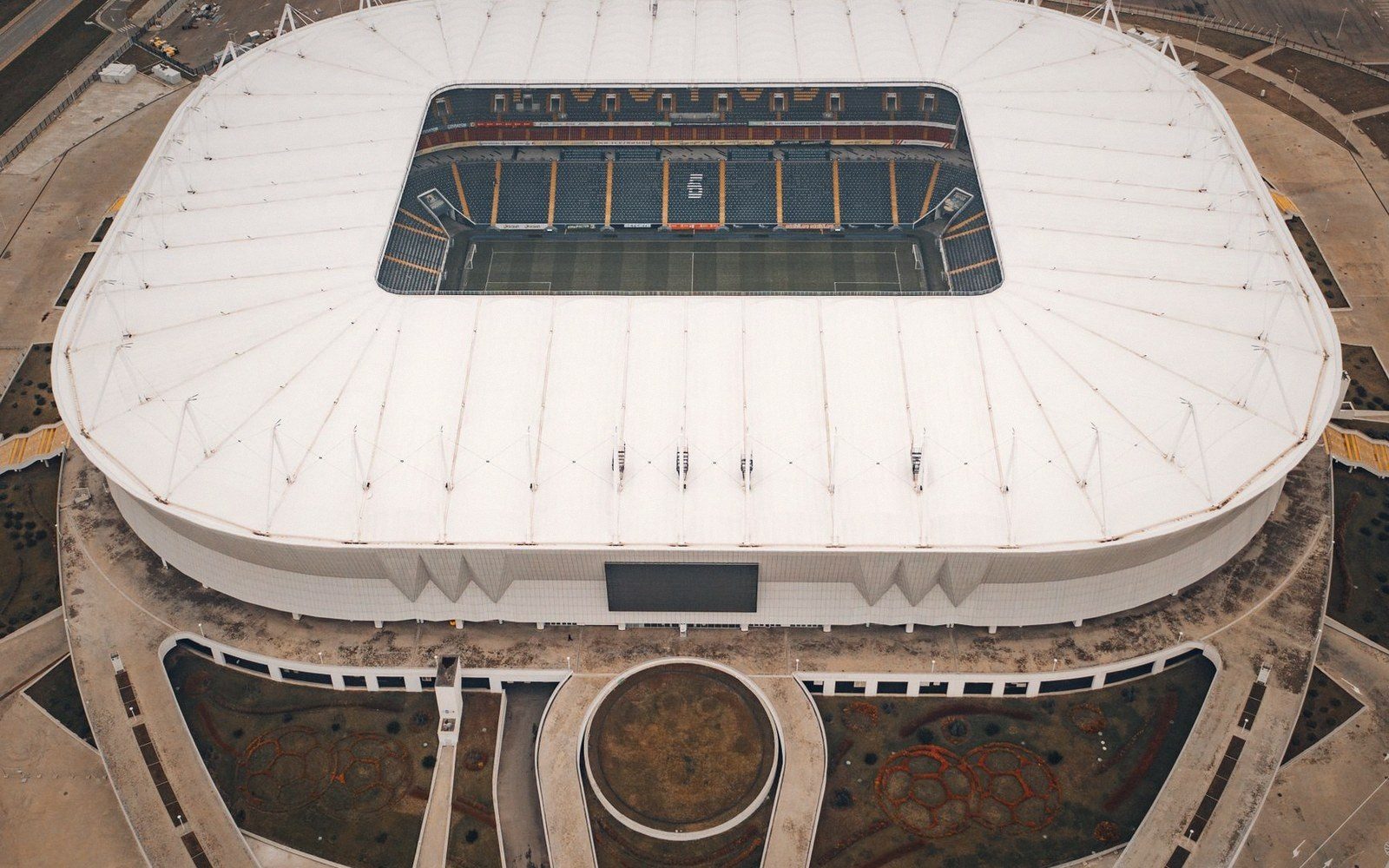
Gwangju used all three. The centrepiece of the new-build programme was the Universiade Main Stadium in the Namgu district, constructed specifically for the games and intended for continued use as a major athletics and football facility afterward. The Aquatics Centre and the gymnastics halls nearby were also purpose-built, clustered around what planners called the Universiade Sports Complex — a deliberate concentration of flagship venues that made the games legible as an event with a physical centre.
Outside that cluster, the picture was more varied. A number of sports used existing university facilities, which aligned neatly with the Universiade's nominal identity as a student competition. Universities in and around Gwangju provided courts, tracks, and indoor halls that needed upgrading rather than replacement — temporary seating, improved timing systems, overlay in the form of tents, fencing and signage that converts a functional sports hall into a competition-ready venue for three weeks and then comes down again. Several venues in other South Korean cities were also incorporated, particularly for sports with smaller followings whose infrastructure requirements were easier to meet regionally than locally.
The split matters for legacy planning as much as for construction budgets. Purpose-built venues carry long-term maintenance obligations that the host city inherits. Converted facilities return to their original operators after handback with modest improvements. Borrowed venues in other cities leave the host city with no obligation and no benefit. What gets torn down and what stays after a games is partly a policy choice and partly a function of what was built in the first place.
Why the number surprises people
The gap between public perception and the actual venue count has a structural explanation. Television coverage of any multi-sport event is heavily concentrated on a small number of high-profile sports. Athletics, swimming, and gymnastics absorb the bulk of broadcast hours. The venues that house archery, shooting, table tennis, fencing, and university volleyball barely appear on screen. But they still require a building, a management team, a transport schedule, a medical plan, and an operational budget.
Shooting alone requires a purpose-built or heavily modified range capable of meeting international federation specifications — noise management, firing lines, electronic scoring, controlled sight lines. It is not a facility that doubles as anything else in the offseason without significant adaptation. The same is true of the judo hall, the taekwondo hall, and the artistic gymnastics arena with its floor specifications and apparatus storage. Each of these is a full facility problem, not a backdrop.
The effect is that the people who actually run a Universiade — the venue managers, the transport coordinators, the overlay teams — are operating across a far larger and more dispersed city than the one the opening ceremony suggests. The games that appears on a broadcast as a coherent spectacle is, from a logistics perspective, thirty separate buildings running simultaneously, each with its own workforce, its own schedule pressure, and its own relationship to the city around it. Gwangju's venue count was not unusual for a Summer Universiade of its scale. What it illustrated, clearly, was the distance between the event as it is experienced and the event as it is built.