What Second Life Actually Requires
Not every sports facility built for a major games becomes a liability. Some find sustained use; others are photographed from drones years later, weeds growing through the athletics track. The difference is rarely about architectural quality or construction cost. It has more to do with decisions made before the ground was broken — about location, scale, ownership, and whether anyone outside the organising committee actually needed the building.
The venues from the 2015 Gwangju Summer Universiade that fared best after the games share a small set of characteristics, none of them glamorous.
The venues from the 2015 Gwangju Summer Universiade that fared best after the games share a small set of characteristics, none of them glamorous. They were sized for realistic post-event demand rather than peak-week capacity. They were placed within or adjacent to existing sport and university districts rather than on greenfield sites chosen for logistical convenience during a fortnight of competition. And they were handed to operators — municipal sports authorities, universities, professional clubs — who had articulated a genuine use for them before the opening ceremony, not after.
The Gwangju Cases
The main swimming venue used for aquatics competition illustrates the point. Gwangju already had a regional swimming tradition, and the facility was designed with lane configurations and spectator capacities that matched the local competitive calendar, not just the broadcast requirements of a Universiade final. Once FISU's technical officials departed and the temporary overlay was stripped back, the venue was in a condition to run regional and national championship meets without significant conversion cost. That alignment between event-week specification and post-event demand is rarer than it should be in multi-sport games planning, and it is usually what determines whether an aquatics centre becomes a community asset or a maintenance burden.
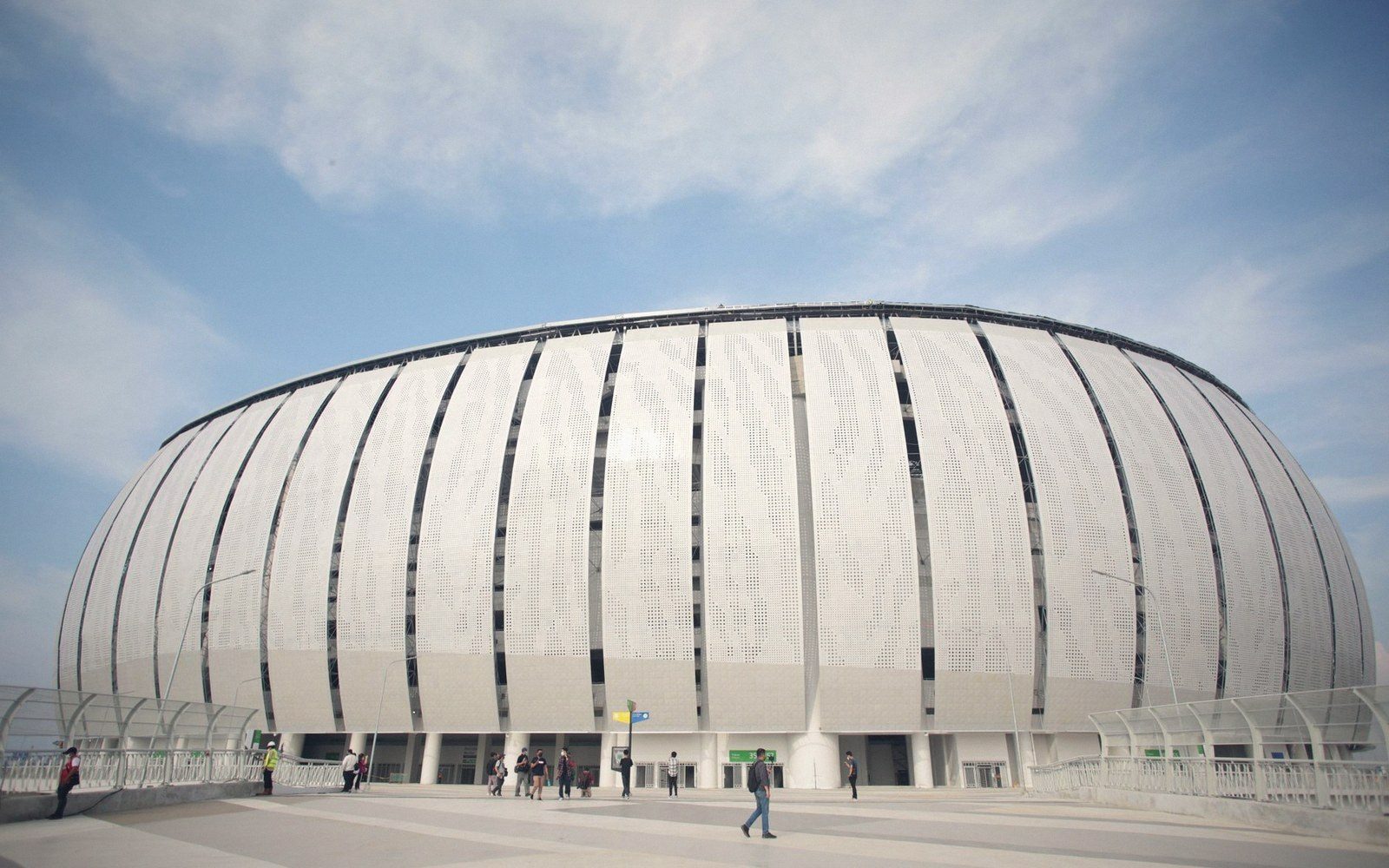
The Universiade Main Stadium in Gwangju occupies a more complicated position. Large athletics stadiums are structurally difficult post-games propositions almost everywhere; the spectator capacity required for a flagship opening ceremony exceeds what a domestic athletics programme can regularly fill. Gwangju's answer was to treat the stadium as part of a broader sports complex — the Gwangju World Cup Stadium and its surrounding sports facilities had been built for the 2002 FIFA World Cup, and the Universiade infrastructure was added to a district that already had transport links, food and retail adjacency, and a population already habituated to travelling there for events. The stadium did not have to create a destination from nothing; it joined one.
University facilities represent the cleanest legacy stories in Gwangju's venue inventory. Several competition venues were hosted on or immediately adjacent to campuses — Chosun University among them — which meant the facilities reverted to academic sporting use without requiring a new management structure, a new funding arrangement, or a new user base. The students were already there. This logic, when it works, is essentially self-fulfilling: a university gym built to FISU competition standard is a very good university gym, and the institution has every incentive to use and maintain it.
What the Failures Have in Common
The venues that have struggled — in Gwangju and in comparable Universiades elsewhere — tend to share the opposite profile. They were built at scale to satisfy a technical specification or a broadcast standard, then handed to a municipality with limited sporting infrastructure and a population too small to generate the footfall needed to offset running costs. They sit outside city centres, accessible during the games by temporary transport provision that disappeared with the accreditation system. Or they serve a sport — artistic gymnastics, for instance, or wrestling — for which domestic competition demand is thin and international events infrequent.
The problem is not that these facilities were built badly. The problem is that the conditions required for their sustained use were never realistic, and the bid document commitments that governed their construction described legacy in terms of aspiration rather than verified demand. An operator willing to take a venue on day one after the games is a much better indicator of likely success than any written plan.

The Pattern That Holds
Across Universiades since the early 2000s, the facilities that aged well were almost always those with pre-existing anchor users: universities, professional clubs, national federations with a domestic programme to run. The facilities that did not had been built for the event itself, justified by the event itself, with a legacy argument constructed to satisfy a bid requirement rather than to describe a genuine plan.
Gwangju's record is mixed in the way most host cities' records are mixed — some venues genuinely useful, others maintained at cost without generating equivalent return. What the successful ones demonstrate is not that ambitious construction is wrong, but that ambition aligned with pre-existing demand is a different kind of project than ambition aligned with a two-week timetable. The calendar drove the cranes. What happened after depended on whether anyone had needed the building in the first place.